
The Bridge
About the bridge
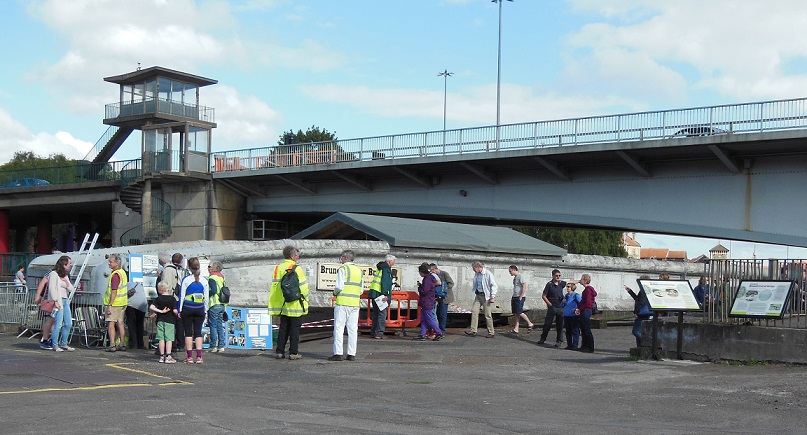
Isambard Brunel’s innovative rotating bridge was originally built to carry a road across his new Entrance Lock to Bristol City Docks. It was built in 1849 in the same dockyard as the SS Great Britain and by the same firm. It still survives today, next to the 1872 Entrance Lock where it provided an essential crossing until made redundant by the Plimsoll Swing Bridge, commissioned in 1968.
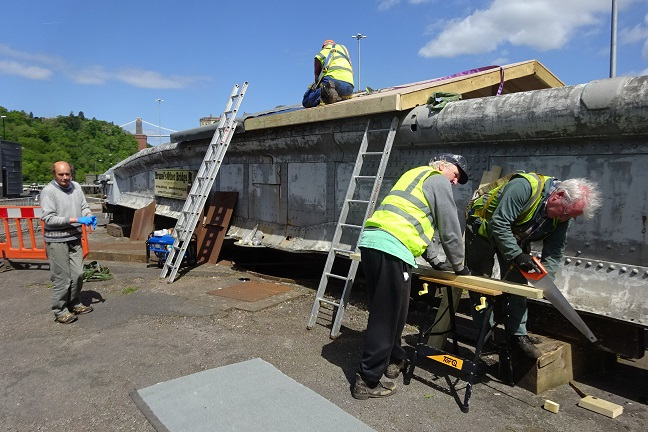
The deck is 33 m (110 ft.) long, weighs about 70 Tonnes, and, although derelict, can still rotate.
The bridge is a Grade 2* listed national heritage asset, which means that it is within the top 4% of the most important buildings in England. However, it is also on Historic England’s Buildings At Risk Register, where its condition is described as ‘very bad’.
Why is the bridge important?
It is remarkable evidence of Brunel’s thinking.
The innovative design clearly reveals Brunel’s creativity at a time when he was developing new ideas for longer, stronger bridge spans. Some design features didn’t work, but those that did were copied elsewhere both in the UK and abroad. This is a pioneering structure, designed at a time of competitive creativity in bridge-building, and a key part of Brunel’s legacy.
It is unique.
The Bridge is the oldest rotating bridge in the world, older than the Clifton Suspension Bridge, and the only early moving wrought iron bridge to survive intact.
It was built in Bristol.
It was constructed in the same dockyard as the SS Great Britain and by the same firm, George Hennet & Co. Despite being severely rusted in places, the structure is substantially complete and can still rotate.
It is an exceptional example of the best of Victorian technology.
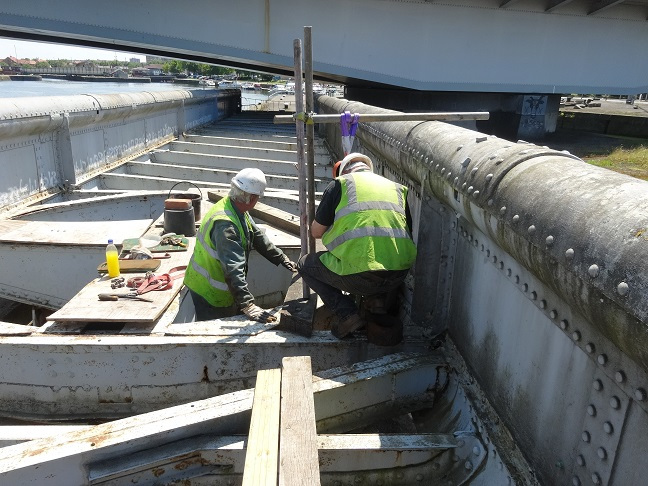
The design is strong but economical and lightweight, constructed over a short period, but to an exceptionally high standard of workmanship.
It is constructed of wrought iron.
This traditional hand made material is no longer made. It was jointed using white-hot rivets, hammered manually, a process no longer used in construction.
It was technologically innovative.
Brunel used tensioned tie-rods to stiffen the side spans, a pioneering example of post tensioning that was copied by other engineers. The Newcastle firm Sir W G Armstrong Whitworth & Co Ltd. supplied a jigger mechanism to rotate the deck using hydraulic water power alone - originally the Bridge had been operated manually. This jigger equipment survives intact, demonstrating the technology that led directly to the oil hydraulic systems used widely in engineering solutions today.
It is historically significant.
The Bridge is recognized by its national Grade 2* listing, putting it in the top 4% of the UK’s most important heritage assets.
Location
The swivel bridge is accessible by foot from Brunel Lock Road. BS1 6XS
By Road: Park in Long Ashton Park and Ride, take bus M2 to Cumberland Basin.
Busses: The Swivel Bridge is 5 minutes walk from Cumberland Basin stop on Route M2 between Bristol City centre and Long Ashton Park and Ride. For routes and timetables, see:
https://journeyplanner.travelwest.info/
What3words: passes.thinks.hunt
There is more information about the swivel bridge on our technical page

